
Sorry Rumi
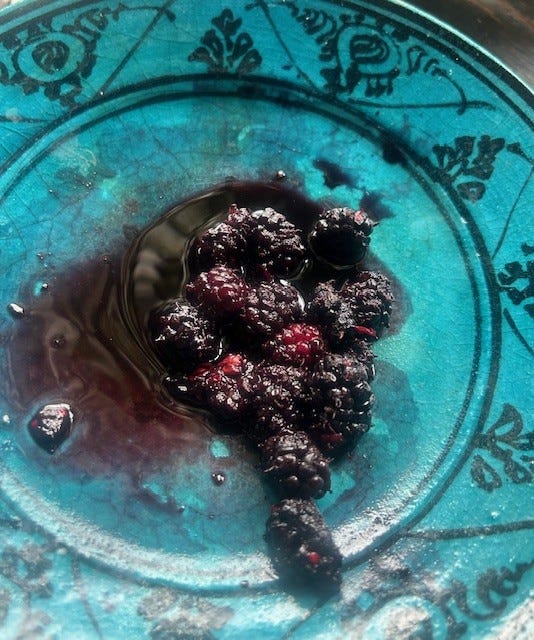
The crack is back! And by crack, I mean the Persian Mulberries, which grace us for two weeks and cannot be glanced at without fingers getting stained. Drunk on their own juices they are the Hafez of berries (sorry Rumi), tang and centuries-old sweetness perfectly entwined. I swear they get you high; dark, wet, black-blooded bits of the eternal. Deeply feminine in texture, flavor, wisdom, this is sex food and I don’t mean to be eaten with it I mean to be eaten as it. Oh, what the Persians know and don’t know. The other night, Iran scored late against Egypt in the World Cup and it was not just a goal but a transcendence. This conflicted, royal land; lorded over from within by theocracy, ruptured from abroad by barbarity, finding hope on the soccer field! The goal scorer tore his jersey off, as if nakedness were the only answer to his ecstasy. His teammates engulfed him, the Iranian fans gone full rapture, not like he had scored a goal but like he had performed a miracle. His brothers kissed his head and face; those ecstatic kisses between men which are the opposite of war— And now onto the knockout round they would go, this moment of victory happening on the world stage for all to see…And then five minutes later, the kisses still wet, the goal was nullified! Disallowed, when the video replay revealed the player “offside” by inches. Technology, which had taken the form of bombers from above, morphing into pinpoint surveillance, the modern world once again coming down on the Persian empire. It was not just a sports cruelty, but a historical one. The players were devastated, but soon their disbelief had turned to wry acceptance, as if continued suffering and the ability to endure it was the only victory one could count on.
And from this enduring soil grow the trees that gift the sweetest morsels. The Rumi berries (sorry Hafez), so delicate they must be picked by brown-eyed angels with felt hands. How magnificent fruit is. Born of the earth and free of slaughter it is the snack of Eden. Fuck protein with its obvious objectives and heavy-handed ways, give me the grace of tree and vine. Fruit is aspirational, goodness reached for, not dug up. You don’t stumble upon a cabbage on a country stroll, but you may come across wild berries, though you won’t come across Persian Mulberries unless you make your pilgrimage to Mecca (whatever Mecca is to you).
My fingers bloodied, my mouth in awe, I think of Abbas Kiarostami, the great Iranian film director and how he understands both the sweetness of life and the stain it leaves behind. I adore his masterpiece, “Close-Up,” but my favorite is his 1987 film “Where is the Friend’s House?” a meditation on human decency and how even a small action taken in the name of empathy can become an epic quest.
The film begins with a rural teacher harshly scolding an eight-year-old boy in his class. The boy starts to cry in a way that is so real and helpless you swear you’ve never seen anyone cry in a movie before. Defenseless against the requirements of school/society he is singled out as the lamb to be sacrificed, but he is not the star of the film. The star is his friend Ahmed, an ancient soul in an eight-year-old’s body. Ahmed disobeys his domineering, preoccupied, yet somehow still loving mother and sets out by foot to find his friend’s house (in a neighboring town) so he can return his school workbook, which has accidentally gotten into Ahmed’s satchel and which his friend needs to not be expelled. Ahmed crosses the threshold, navigating modern Iran and ancient Persia (which are one in the same here) with only the goodness of his intentions to guide him.

Half documentary, half fable, “Where is the Friend’s House?” is the work of a maestro, but it’s not just filmmaking Kiarostami is a master of, he is a master of heart and place. Religiously unsentimental and always tender, he gets to the essence of Persian poetry and storytelling and though I am uneducated on both subjects, I know what I’m saying is true.
What is it about those berries that doesn’t just please my mouth but opens my heart? Why am I so moved by those Persian athletes kissing their hero, unafraid of wild displays of love and joy? What is so profound about Kiarostami smiting indifference with a small boy’s need to save his friend from exile? Oh, what the Persians know and don’t know.
Wow....some of your phrases are like these mulberries. Juicy....although i have never tasted a mulberry...i tasted one reading you. K is a great director indeed.
Whilst attempting to source Sufi Berries (sorry: Tommy, Hafez & Rumi) in nyc, I find myself wtf-ing over «ruptured from abroad by barbarity»??