
Take What She's Got
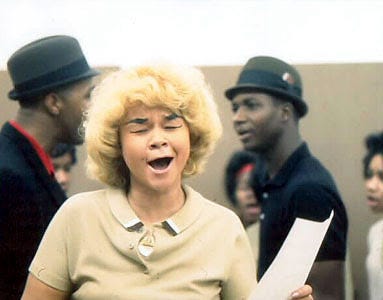
There are certain records that are perfect and by perfect, I mean they sound as if they were handed down from on high. “I’d Rather Go Blind” by Etta James is one of them. The track starts with a triplet of guitar notes and a Hammond B3 (organ) humming in your ear. The beat is just side stick on snare rim, the bass nodding its head and providing moral support. Then Etta shows up and it’s on.
“Something toooold me it was ooover.” She’s so sad the back-up singers have to come in after one line just to let her know she’s not alone.
“I would rather, I would rather go blind, boy, then to see you walk away from me (child),” is a classic lovelorn lyric, but in Etta’s hands (mouth) it becomes a lament for all heartbreak and rejection. There’s a simple five-note horn part that splits the line and acts as a comforting hand on her shoulder (all the instruments are easy as noodles and butter, because Etta’s so heartsick that’s all she can eat). By the time she sings “I was just, I was just, I was just sittin’ here thinkin’--” you’re ready to go blind with her.
I love the song so much, I decided to buy the vinyl. It’s on an album called Tell Mama (1968, Cadet Records). I played it every day as I did my morning stretch, and after a few listens I began to notice something, and what I noticed was that lyrically, at least from a 2026, mental health/what’s your attachment style perspective, the songs were completely batshit crazy.
The takeaway of I’d Rather Go Blind is that Etta, having seen her man walking and talking with another woman decides (just from that) that it’s over, and not only is it over, but she would rather lose the gift of sight than her dude. At one point she sings “Most of all, I just don’t want to be free,” her reading turning freedom from a glory to a curse. (The choice of the word “free” over alone, a flash of poetic brilliance.)
I’d Rather Go Blind is the second cut on the album and it turns out to be the sanest song on the first side. The opening track is, “Tell Mama.” A well-known soul classic that starts with a snare shuffle, rollicking upbeat horn part and funky R&B rhythm guitar before Etta comes in triumphantly! Turns out her triumph is that the man she wants has been done dirty by the woman he chose over her. But it’s all good; Etta is there to help him pick up the pieces. She wants him to “Tell mama all about it/ tell mama what you need/tell mama what you want, and I’ll make everything alright.”
The song was written by three men, and it’s a great male fantasy. Dude gets humiliated by a woman, and not only is old reliable going to take him back she wants to hear his tale of woe. It’s a low self-esteem free-for-all and way too boundaryless for the relationship guidelines of the 2020s. If it were written today, the woman would realize her self-worth by the bridge, then kick him to the curb in the last verse, rejecting the role of mother/lover before moving on to greener pastures.
Track #3 is “Watch Dog.” An upbeat R&B ripper that kicks off with Ikette (The backup singers behind Ike and Tina) style background vocals before Etta joins the party pissed off and ready to set things straight...
I don’t want no watch dog, I want a man, uh-huh
I don’t want no watch dog, I want a man right now
I don’t want no man of mine
Everywhere I go, now, he’s a-right behind
I don’t want no watch dog, I want a man
In the first tune she wanted her dude’s attention so bad she was willing to be sloppy seconds. On the next she’d rather Ray Charles herself than lose her hero’s love. But on track three, her dude is a possessive pipsqueak, sniffing after her wherever she goes, and Etta has had enough. When she sings “I’ve never had a man peeping and a-hiding/
When he should be out working and providing” you realize dude is so jealous, possessive and obsessed he can’t even hold a job. But we are PRO (pre-restraining order) and it seems Etta would rather be stalked than neglected, especially if she gets to talk a little shit in the process.
Watch Dog was written by Don Covay. I’d rather Go Blind was written by Ellington Jordan and Billy Foster. Etta wrote in her autobiography Rage To Survive* that she heard the song outlined by her friend Ellington “Fugi” Jordan when she visited him in prison. She then wrote the rest of the song with Jordan, but for tax reasons, gave her songwriting credit to her partner at the time, Billy Foster. I don’t know what “tax reasons” is subtext for but a song about her relationship with Billy Foster sounds like it would fit on this album well.
Track #4 is “The Love of My Man.” A gospel inspired ballad where the word “Jesus” is replaced with “my man.”
The love of my man
Keeps me safe and warm
The love of my man
Protects me, protects me from all harm
‘Cause I know, I know he loves me
And I, I love him so, yes, I do
And oh, the love, the love, the love of my man.
She sings with it with Baptist reverence, but it sounds more like wishful thinking, and I don’t think she buys it for a second.
And oh, the love, the love, the love of my man
(The love of my man, uh)
It makes my whole life,
Makes my whole life worth living
That is definitely not Bell Hooks approved literature, and though this ode to the patriarchy is way out of touch with the current zeitgeist it’s equally out of touch with the three songs that came before or maybe it’s a just another ink blot in the Rorschach test of black female love circa 1968 (ink blots all written by men).
Shockingly, (or not shockingly) those four ditties pale in comparison to “I’m Gonna Take What He’s Got,” which turns Stockholm Syndrome into an Olympic sport with Etta bringing home the gold.
He beat on me
He cheat on me
He’s mean to me ooo but he could be so sweet to me
My friends say I should give him up
But ohhhh I need him I need him a lot
That’s why I’m gonna take it (take it take it)
Take what he’s got.
Wow. It was one thing when Billie sang, “I’d rather that my man would hit me, then that he would up and quit me, ain’t nobody’s business if I do,” but that was the 40’s. This is 1968. The Panthers are doing it up in Oakland, Medgar and Malcolm have come and gone and King is just about to. Betty Friedan has made her case for (white) women, but here is Don Covay, going back to the darkest of wells. A change may be coming for Sam Cook, but Etta’s gonna have to eat that old school slop. She may not be thrilled about it, but she’s no stranger to it, and there’s a twisted defiance in both the lyrics and performance. (Just like Billie, the only real power she has is doing whatever she wants, even if it’s self-defeating—any port of autonomy in a black female storm.)
He cause me pain, you make me wait sometimes out in the rain
You can make me feel ashamed but I never dress the same
And I love him so much nothing can make me stop
That’s why I’m gonna take it (take it take it)
Take what he’s got
He makes her wait out in the rain?! With that wild blonde hairdo? Now, that’s beyond the pale. I’m making a joke, because it’s so twisted and if you handed that song to a singer today (as a new song) she’d think you’d lost your mind but it’s 1968 and Etta’s like “Just tell me what key and let’s go.”
And that comes right after “The love of my man keeps me safe and warm.” It’s not a R&B album, it’s a schizoid bipolar confession. She’s trapped in these songs written by men, like she’s trapped in a world written by men, but she makes the songs hers with her power and brilliance and is anything but a victim—at least not in front of the mic.
So, what do we make of Etta James singing “Take What He’s Got” here in these wonderful woke times of ours? No doubt, it is some dark, dysfunctional, violent, backwards shit, but I don’t want my art sanitized or psychologically clean, and I sure as hell don’t want my blues singers that way. Art is where we get to revalue what’s broken in us. Where we can take ownership of our grief and have it work for us and not the other way around. Etta James connects to a primal, timeless impulse that transcends “healthy boundaries.” She is a martyr, not by choice but by circumstance. She takes the disturbed colors of the (female) African American experience and paints the ceiling of the Sistine chapel with them. She milks addiction, abandonment, self-loathing, love, rage, and heartbreak and churns it into soul butter. She collects her wound rain in a big ol’ barrel and when she sings she don’t waste a drop. That’s why I’m gonna take it (take it take it) take what she’s got.
*Rage to Survive was written by my pal David Ritz. Upon completion of the book Etta asked him to read it to her. When he finished, she said, “You pissed all over that.” He says it is the best compliment he’s ever gotten.
This very daring article explores and evaluates the songs of blues legend, Etta James, which are basically the songs of a woman being mistreated by her man (or men) and seeming to revel in it, in stark contrast to all the “ relationship guidelines” for this current era of “healthy boundaries”.
So, does art - real, authentic art - transcend these guideline and still survive, regardless?
This is Tommy’s answer, and it really bears thinking about, “Art is where we get to revalue what’s broken in us. {Etta James} … takes the disturbed colours of the female African American experience and paints the ceiling of the Sistine Chapel with them.”
What an interesting image that is, and one that ultimately points the listener towards the work, the voice, and the way this artist churns heartbreak into “soul butter”.
This post sent me straight to Etta James for the full experience. And it got me thinking of Zora Neale Hurston, who also "milks addiction, abandonment, self-loathing, love, rage, and heartbreak and churns it into soul butter. She collects her wound rain in a big ol’ barrel and when she sings she don’t waste a drop." I've read Their Eyes Were Watching God twice in three years. Nobody writes like Zora.